Gwent's Breeding Curlews 2026

Gwent's Breeding Curlews 2026

Andy Karran

A 2026 update on Gwent's breeding curlews.

In spite of a disappointing decline in the number of breeding pairs this year – 16-18 compared with 21-24 in 2025 – we had several successes and much to our delight there was no downturn in the number of nests – four were found and five, perhaps six, chicks were seen.

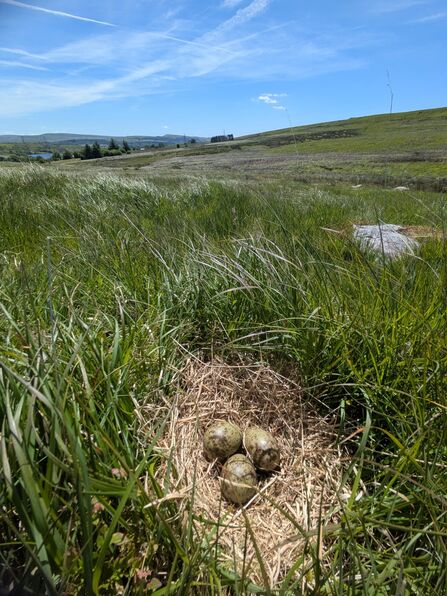
Finding nests is always difficult but this year it was particularly hard.  Alarm calls and defensive behaviour alert the observer to the likely location of a nest but, curiously, Curlews seemed quieter than usual this spring.  We suspected nests in several general areas but couldn’t pin them down to a specific field.  Interestingly, the dates indicated that several of the nests we did find were unusually late, probably replacements for earlier, failed breeding attempts.
 

Curlew egg nest in green grass

Simon Hockin

Happily, the habitat in the Trellech area clearly suits Curlews.  Two nests were found and the nest field of a third pair identified.  A caring farmer contacted me saying he was about to mow so we walked in to search and flushed a sitting bird just 2-3 metres away!  Huge excitement all round – four eggs!   We staked an area 20m x 20m around the nest (it was too late to fence) and the farmer very generously left this area uncut; when subsequently mowing the contractor saw two or three tiny chicks.  Miraculously, the parent birds managed to lead the chicks across the very busy Trellech-Llanishen road but though alarm calls indicating chicks were heard for several days, after a while all went silent, suggesting probable predation.  

Another nest in this area was found by a different farmer when mowing and he too left an area uncut. Sadly, when checked several days later the nest was empty, a fox being the presumed predator. 

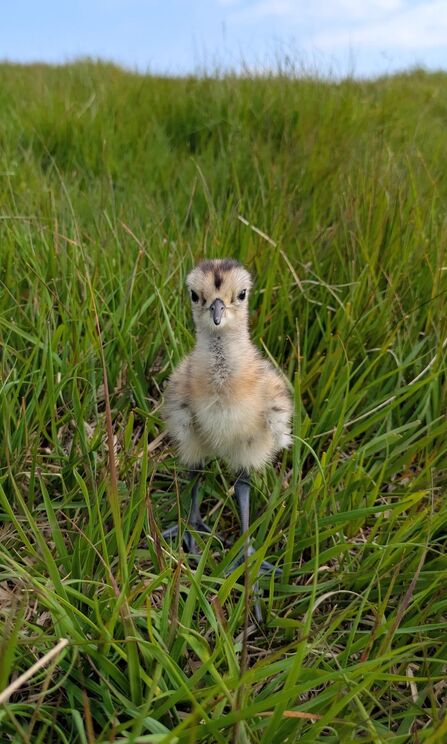
However, there was great news at the third Trellech site: the parent birds led at least one chick several fields away from the likely nest field and on several days up to 19 June the male was seen attentively guarding a 3 to 4-week-old chick.  Did this chick fledge? Maybe, maybe not. 

Still in east Gwent the Newchurch pair returned to their usual field but though breeding was suspected we weren’t able to pinpoint a nest.  In central Gwent a pair seen regularly on the Llangybi floodplain survived the horrendous spraying of all the surrounding fields but monitoring became difficult.  It’s probable that these two pairs failed to breed.

uncut patch on a green field

David Probert

A curlew in tall grass

Verity Picken 

Monitoring at Brynygwenin, another site in north Gwent where we’ve twice found nests in the past and where a chick fledged last year, proved tricky.  Adult alarming and behaviour indicated chicks but frustratingly, no nest was found.  It’s likely two pairs were present. 

Two breeding pairs were observed regularly further north – one at Llangattock Lingoed in a field where Curlews nested in 2024 and the other at a new site nearer to Grosmont – but despite our efforts we weren’t able to locate their nests.  We learned rather late in the season of a pair to the west of Llangattock Lingoed. 

Interestingly, two Curlews which had been GPS-tagged in Herefordshire were tracked to two locations near here, both on 13 June.  Amazingly, one of these birds, a female, set off again at 11.30pm and reached Southampton Water at 5.50am the following morning; she rested a while before continuing and arriving at North Solent, south of Lymington, later the same day – a distance of 185.82 km!  Tagging Curlews is amazingly valuable as not only does it give fascinating information on migration routes and possible wintering sites but can lead to the finding of nests.  This year four Curlews tagged in Herefordshire led to five nests being found (one bird nested a second time). 

Llanwenarth, a site which held breeding Curlews for many years, appears to no longer be attractive to them.  Singles were sighted on just four occasions, the last on 1 April.  A Curlew was heard three times near Oldcastle, close to the Herefordshire border, but no sightings were reported.  

Breeding pairs on Gelli-gaer Common, Cefn y Brithdir and Blaen Rhymney proved elusive.  Elsewhere in the northwest, Curlews returned to the usual site near Markham in mid-March but disappointingly disappeared after 3 May. On a recent (August) visit to see local farmers Simon Maggs was told that a chick had been seen in fields slightly further north.  Good to hear but disappointing not to have known about it earlier.  Though remarkably site-faithful, it’s not unusual for Curlews to change nest fields and at least we now know where to look next year! 

Sian Howley and Rich Poole took a load off my shoulders this year, helping with co-ordinating the monitoring and engaging with surveyors, residents and farmers – it was much appreciated.   Huge thanks go to all who took part in the monitoring, whether village residents, casual observers or regular surveyors – Scott Crichton, Gary Howells, Arthur Pitcher, Bev Lindsay, Gillian Knowland and others put in many hours. 

Farmers are absolutely essential to our efforts to save Curlews and I am extremely grateful to them, both for allowing access to their land and for delaying mowing; special thanks go to David Probert, Neil Parry and Tracy and Wayne Langford.  

The numbered field maps produced for us by SEWBReC made reporting the location of sightings far easier and their help with assigning grid references to field numbers saved a great deal of time.

We all know Curlews are at risk of becoming extinct as a breeding species in Wales within the next 7 years – with your help we can try to stop that happening.

Verity B Picken

Curlew Lead, Gwent Ornithological Society